What is Redundancy in Networking?
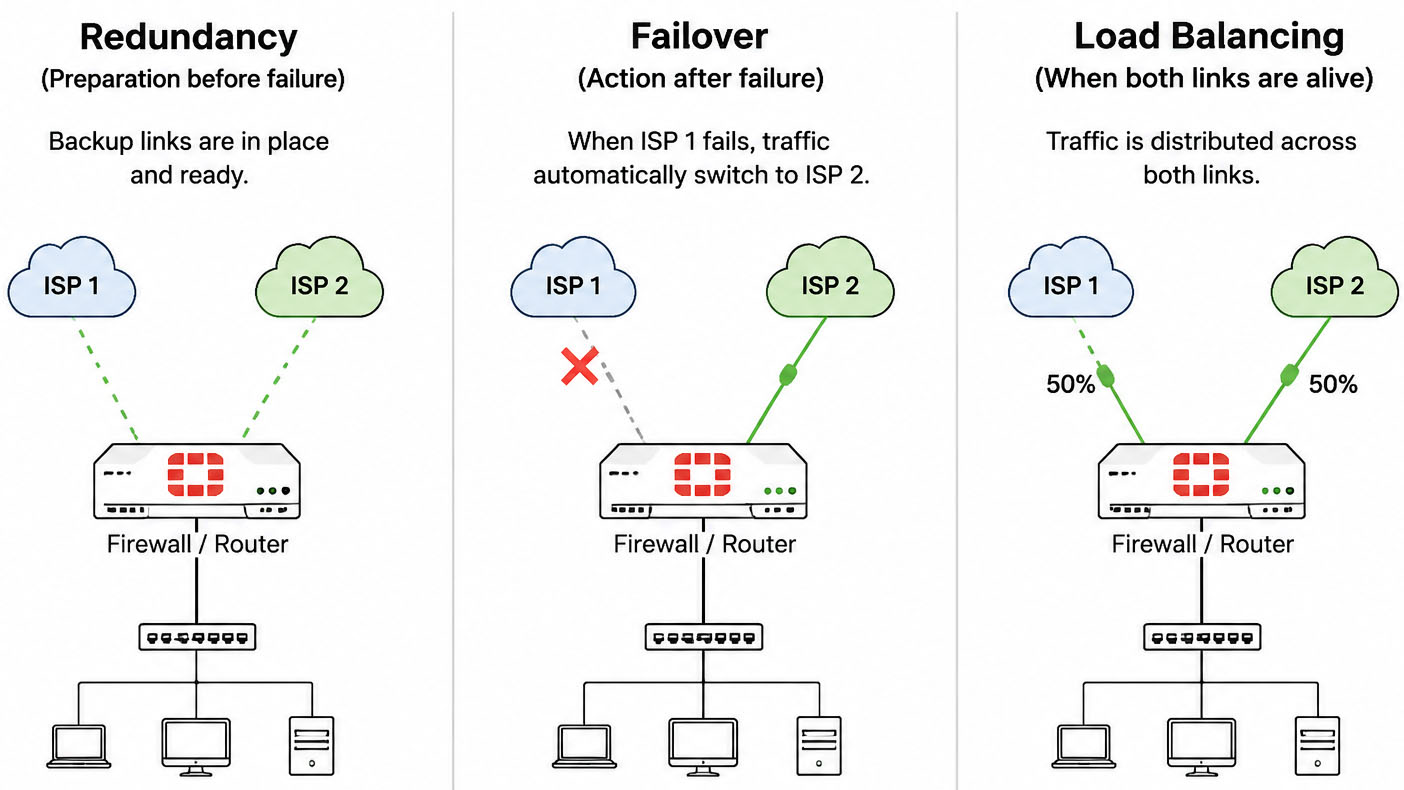
Redundancy is the practice of preparing for system failure before it happens.
It means having extra or duplicate components such as internet links, servers, power supplies, or network devices. These backup resources are always available in case the primary system fails.The main purpose of redundancy is to ensure high availability and minimize downtime in business-critical systems.
👉 Example: Using two ISP connections instead of one to ensure internet access even if one fails.
What is Failover?
Failover is the automatic or manual process of switching to a backup system when the primary system fails.
When a failure occurs, the system detects the issue and redirects traffic or services to the redundant backup system. This helps maintain service continuity with minimal disruption.Failover is a key part of high availability (HA) network design.
👉 Example: If ISP1 goes down, the system automatically switches to ISP2 without user interruption.
What is Load Balancing?
Load balancing is a technique used to distribute network traffic or workloads across multiple active servers or internet links.
Unlike failover, load balancing works while all systems are operational, ensuring that no single resource is overloaded. It improves performance, speed, and resource utilization.Load balancing can use different methods such as round-robin, weighted distribution, or least-connection algorithms.
👉 Example: Splitting user traffic across two internet links to improve speed and stability.
Key Difference Between Redundancy, Failover, and Load Balancing
- Redundancy = Preparation before failure (backup systems ready)
- Failover = Action after failure (switching to backup system)
- Load Balancing = Performance optimization during normal operation (traffic distribution)
Conclusion
Redundancy, failover, and load balancing are fundamental components of a reliable IT infrastructure. When properly implemented, they help ensure high availability, better performance, and minimal downtime, which are critical for modern businesses.